
Planning a trip to Morocco and wondering if the Sahara is worth the long journey? Here’s my honest take on a 3-day Merzouga and Sahara desert tour from Marrakech. We booked through GetYourGuide for just €73 per person: an incredible deal considering what’s included. I’d happily do it again, though there are a few things I’d change. Here’s what to expect, along with tips from my experience.

Why Choose a 3-Day Sahara Tour from Marrakech?
The Sahara is Morocco’s most famous landscape, but getting there on your own requires long drives and careful planning. A 3-day tour handles all the logistics, taking you over the Atlas Mountains, through kasbahs and oases, and finally to the golden dunes of Merzouga. The changing scenery along the way, mountains, valleys, and desert, makes the drive as much a part of the experience as the destination itself.
Day 1: Tizi n’Tichka Pass, Aït Ben Haddou & Tinghir
The tour starts early in Marrakech, heading over the spectacular High Atlas Mountains. We started with the Tizi n’Tichka Pass, Morocco’s highest major mountain pass at 2,260 metres. The stop is brief, but the panoramic views of valleys and terraced hillsides clearly show the scale and ruggedness of the Atlas Mountains.
Continuing through the mountains, we reached Aït-Ben-Haddou, a UNESCO-listed ksar that once played a key role along the historic caravan route between the Sahara and Marrakech. This fortified village is built entirely from earthen clay and straw. The site has also gained international fame as a filming location for productions such as Gladiator and Game of Thrones. Local artists demonstrated how they create paintings using saffron and heat to reveal the colours, a fascinating craft to witness.


Unfortunately, we didn’t have much time to explore, the visit felt rushed so the group could move on to a long lunch stop. That was genuinely disappointing, as this is one of the few places on the route where you can truly feel Morocco’s layered history.
Along the way, we also passed through Ouarzazate, often called the “Gateway to the Desert.” Known for its film studios and strategic location along historic trade routes, the city serves as a logistical hub for travellers heading toward the Sahara.
Overnight in Tinghir
Instead of Boumalne Dades, we spent the night in Tinghir at Hotel Palm Barraoui. The hotel was somewhat dated, but we were given a four-bed room entirely to ourselves, which felt like a luxury after a full day on the road. Comfort was basic, yet after hours of travel, a simple bed and a quiet room were more than enough.

Day 2: Morning Walk in Tinghir, Todra Gorge & Arrival in the Sahara
After breakfast on the second day, we started with a morning walk in Tinghir, which offered a glimpse into daily life in this oasis town. Surrounded by palm groves and traditional mud-brick houses, Tinghir sits along a fertile valley that contrasts sharply with the arid mountains beyond. The walk itself was pleasant, but it eventually led us into a carpet shop where the focus shifted more toward selling than explaining the craft. There wasn’t much cultural context provided, so it felt more like a commercial stop than an educational visit.
Shortly afterwards, we visited one of the most impressive natural sights of the trip: Todra Gorge, also known as the Todrakloof. This dramatic canyon was carved by the Todra River and features towering rock walls that rise up to 300 metres high while narrowing to just a few metres wide at certain points. Walking through the gorge was a refreshing contrast to the landscapes we had crossed the day before. Small stalls and local vendors line the path, and it’s easy to imagine how this natural corridor has served travellers and traders for centuries.


On the way toward the desert, we stopped briefly in Kalaat M’Gouna, but only at a small shop, so we didn’t see much of the town itself. Known as the “Rose Valley,” it’s famous for its rose products.
Quad Biking in the Sahara
Before going on the tour, we booked a quad biking experience in advance through Whatsapp (€50 for one quad, €70 for two people on one quad), and this turned out to be one of the absolute highlights of the entire trip. Riding the quad across the dunes, even in a light sandstorm, was an unforgettable experience. If you’re considering it, definitely book in advance: it’s worth every dirham.
Choosing Not to Ride Camels
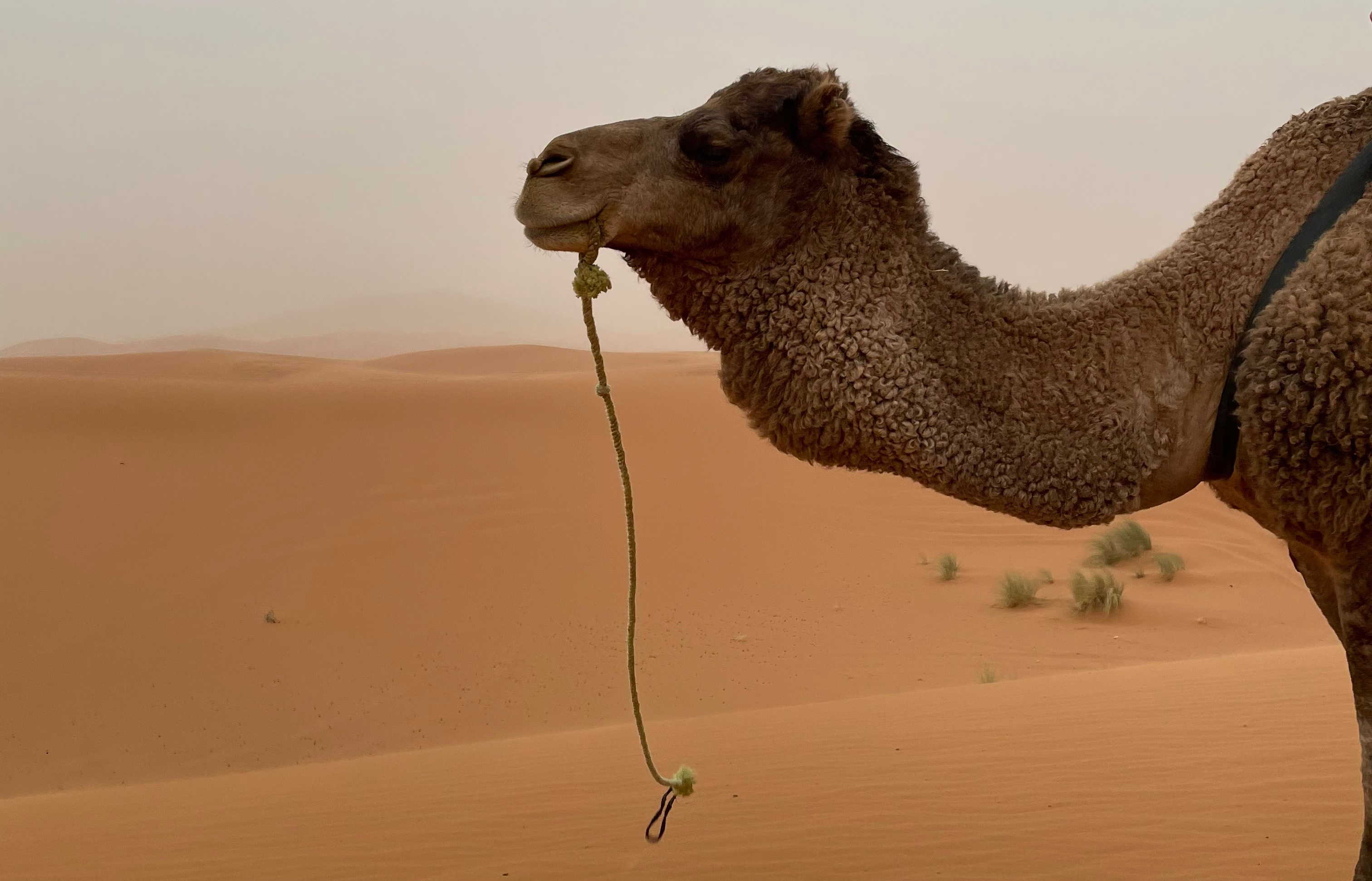
We decided not to ride camels and instead walked alongside them. Personally, we found the idea of riding them uncomfortable and didn’t want to support the practice. Walking was perfectly manageable (a little bit exhausting haha) and allowed us to experience the desert at a slower pace that felt more aligned with our values. As an added bonus, we later returned by jeep instead of camel, which suited us much better.
Desert Camp in Erg Chebbi
Arriving near Erg Chebbi felt almost unreal: endless dunes stretching to the horizon and complete silence. These dunes can reach heights of up to 150 metres and constantly shift with the wind, making the landscape feel alive. That evening we gathered around a campfire with music, it was relaxed and social, a nice way to end the day.


Day 3: Sunrise, Nomad Village & Return to Marrakech
On the final morning, we had the option to book an extra activity for 100 dirhams (about €10): a jeep excursion to a nomad village roughly 15 km from the Algerian border, followed by sunrise in the dunes. Breakfast was planned at 6:00 AM but this turned out to be 6h30, so we got up at 5h30 for nothing haha.
The visit to the nomad village itself wasn’t particularly impressive: you get some tea, a short guided walk around the village, and the little goats roaming around were probably the most entertaining part. The highlight of the morning was definitely the jeep ride through the dunes. Sitting in the back of a jeep as it bounced over sand dunes is not something you experience every day. The drive alone made the trip worthwhile. Watching the sunrise from the top of the dunes during this ride was stunning, the light over the sand, with the shadows changing as the sun rose, was beautiful.
After the jeep returned us to the bus, we started the long journey back to Marrakech. The drive is long, but the driver stopped regularly. At one point, he even stopped by his family’s house along the way for tea and cookies, a nice personal touch.


Practical Tips
- Bring enough cash in dirhams for lunches, tips, and optional activities.
- Lunch stops are pre-arranged and sometimes overpriced. Feel free to ask for a simpler dish or skip if possible.
- Don’t hesitate to ask for the bill early if you want to continue exploring, lunches can take a long time.
- Consider buying a small jar where you can put in Sahara sand as a souvenir. They sell them once you get closer to Merzouga.
Is It Worth It?
For €73 per person, this tour gives excellent value: transport, accommodation, desert experience, and access to hard-to-reach landscapes. Some stops are rushed, and some are sales-focused, but overall, it’s a solid way to experience the Sahara without too much planning. The journey is long, but the desert and mountains make it worthwhile. If you’re debating whether to do it: go. It’s a memorable trip with relatively few downsides.


Leave a Reply